
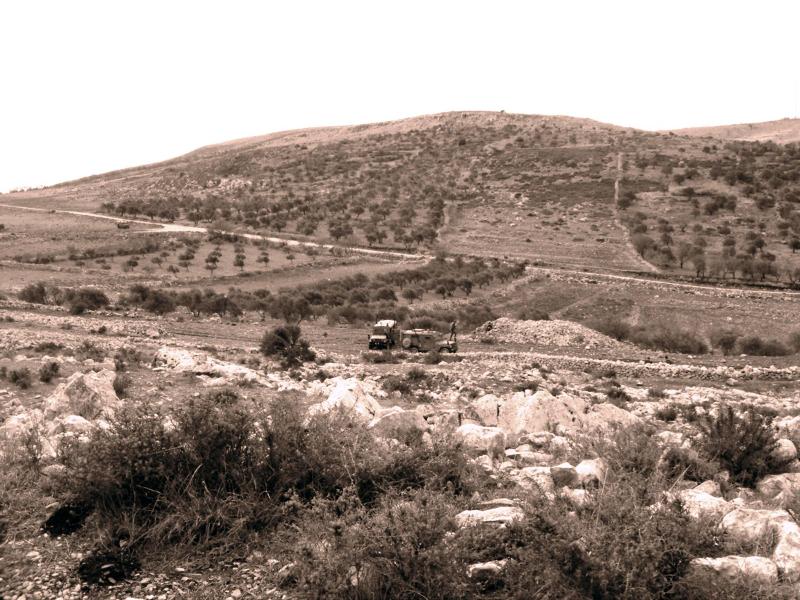
Mount Ebal is not a famous tourist site. It is a bare ridge in the hill country of Samaria, and for most of history nobody had reason to look at it twice. But the Bible gives it a very specific role.
In Deuteronomy 27, Moses commands the Israelites that once they enter the land, they are to go up on Mount Ebal, build an altar of uncut stones, and pronounce the covenant curses from it. In Joshua 8:30-31, that is precisely what happens: Joshua builds an altar on Mount Ebal, exactly as commanded.
Archaeologists working at that site recovered something remarkable — a tiny folded tablet of lead, roughly 3,200 years old.
Lead does not decay the way organic material does, and folding it protected what was written inside. When researchers were able to read the inscription, they found an early Hebrew text that reads: "Cursed, cursed, cursed — cursed by the God YHW."
Two things about that make it extraordinary.
The first is the word YHW — an early form of the divine name, Yahweh. This places a written reference to the God of Israel in the period of the Judges, centuries earlier than critics long argued Hebrew writing of this kind existed. The standard sceptical position held that the Israelites of this era were essentially illiterate, and that the texts describing them were composed many hundreds of years later by scribes with no real access to the events. A written invocation of Yahweh from this period undercuts that position directly.
The second is the content. The tablet does not contain a shopping list or a property record. It contains a curse — the exact category of pronouncement that Deuteronomy 27 says was to be declared from this exact mountain. The object matches the text not only in date and location, but in function.
That is the kind of alignment that is very difficult to explain as coincidence. A curse inscription, naming the God of Israel, in early Hebrew, from the right century, recovered from the one mountain in the world that Scripture designates as the place where curses were to be pronounced.
The Bible described this event more than three thousand years ago. The ground at Mount Ebal has now produced an artefact that fits the description.
Mount Ebal, above Nablus. Photo: Daniel Ventura, CC BY-SA 3.0, via Wikimedia Commons.