
Exodus 14 records the Egyptian army pursuing Israel into the divided sea, and the waters returning over the chariots and horsemen — the whole host of Pharaoh, lost in the water.
Explorations in the Gulf of Aqaba have recovered objects consistent with that account.
Investigators have documented coral-encrusted artefacts resembling chariot wheels, axles, and structural fragments on the seabed. The forms are dated to the late Bronze Age, and specialists examining the wheel designs have identified them as consistent with Egypt's 18th Dynasty — the period that aligns with the biblical Exodus.
The location matters as much as the objects. The finds lie along a submerged land bridge — a shelf running across the gulf, shallower than the water on either side, exactly the kind of crossing point the account describes. Among the material are remnants that appear to be human and animal remains.
But the most telling detail is the coral itself.
The formations were found on open sand, where coral does not naturally grow. Coral requires a hard surface to anchor to. Larvae drift until they encounter something solid, attach to it, and build outward from that anchor across generations. On bare sand, there is nothing to grip and no colony forms.
Which means the coral in these formations grew around something. The objects came first. The coral built onto them over centuries, taking their shape as it went.
That process has had an unintended effect: it preserved them. Metal and wood on a seabed corrode and disintegrate. Encased in coral, the outlines survived — the spokes, the rims, the axle forms — held in the shape of the object long after the object itself decayed.
Wheel forms matching Egyptian chariots of the right dynasty. Human and animal remains. A submerged crossing point. And coral growing in a place it cannot grow unless something solid was lying there first.
The floor of the Gulf of Aqaba is holding the shape of Pharaoh's army.
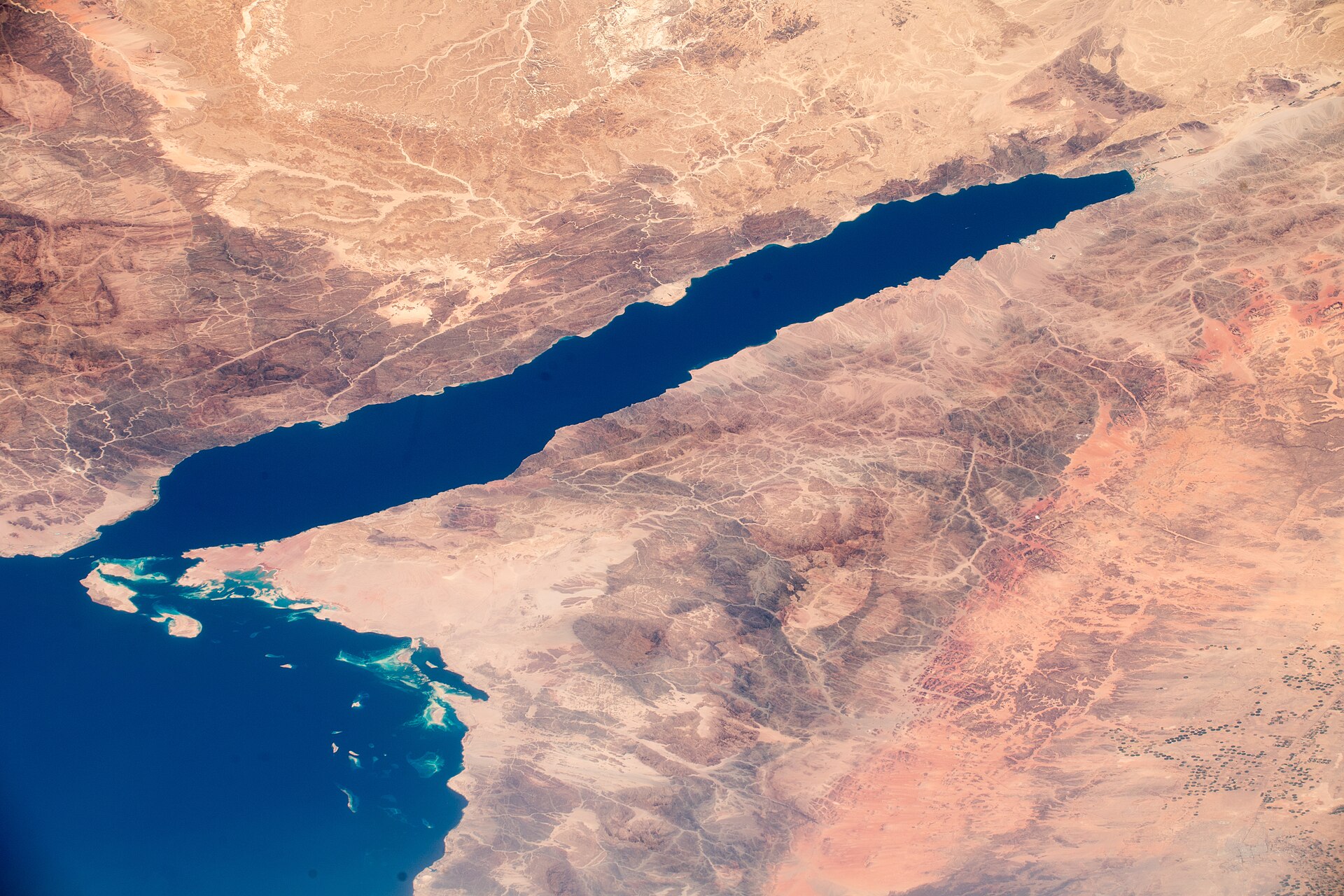
The Gulf of Aqaba. Photo: Alexander Gerst, CC BY-SA 2.0, via Wikimedia Commons.