
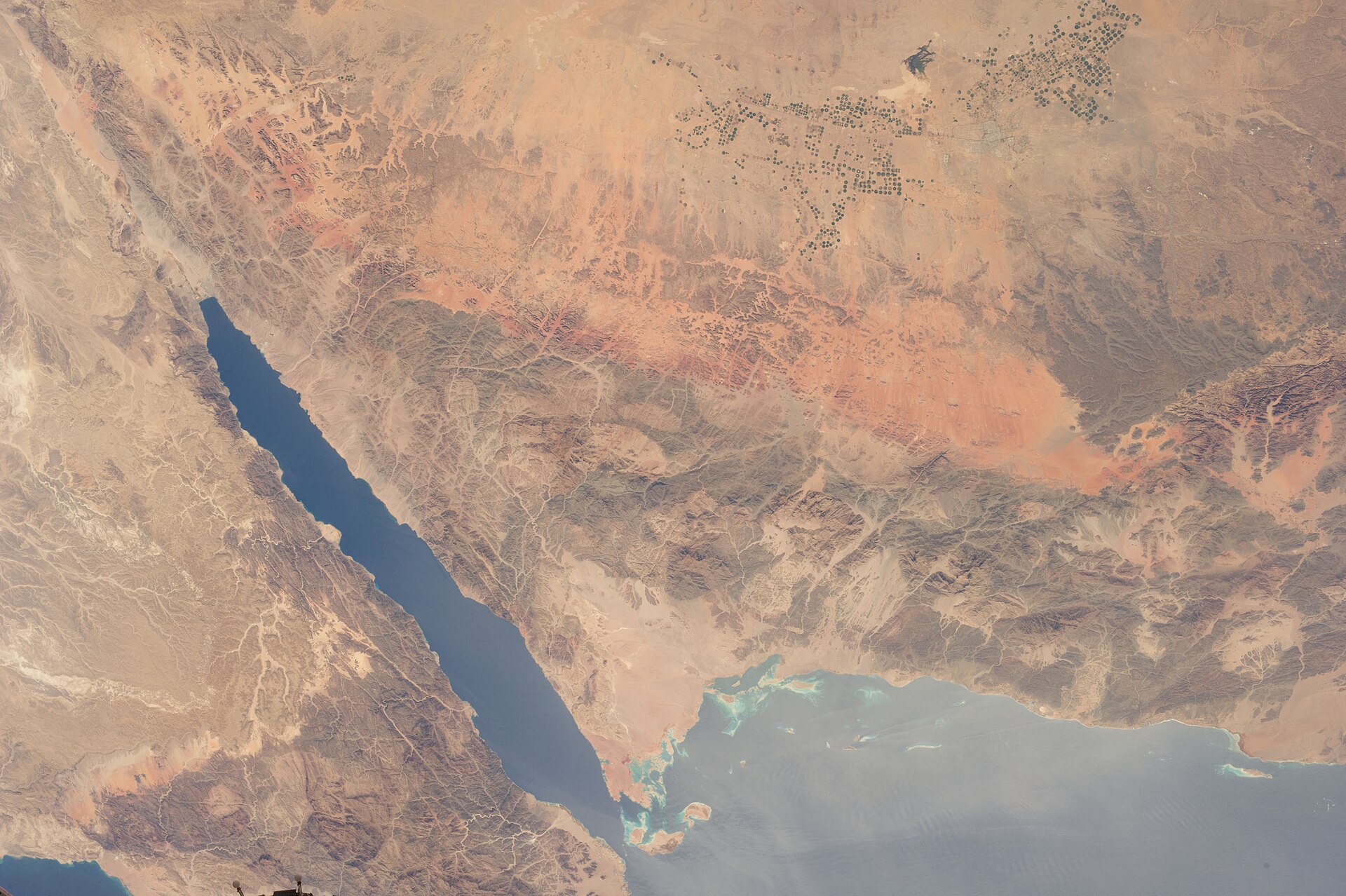
Traditional maps place Mount Sinai in the Sinai Peninsula. But in north-western Saudi Arabia there is a mountain called Jebel al-Lawz that has drawn serious attention as the real location — and the reason is what covers its peak.
The summit is scorched black.
Exodus 19:18 describes what happened on that mountain: "And mount Sinai was altogether on a smoke, because the LORD descended upon it in fire." The blackened cap sits on top of a mountain whose lower slopes are ordinary rock, which is not the pattern weathering produces.
The site holds more than that.
Around the base are large boundary stones, set out to mark a perimeter. Exodus 19:12 records the command that made such a perimeter necessary: set bounds around the mountain, and do not let the people go up or touch its border. The stones sit where Scripture says a boundary was to be established.
Nearby stands a structure built of piled stone, understood to be the altar where the golden calf was set up. And etched into those stones are carvings of cattle in Egyptian style — bovine figures rendered in the artistic conventions of Egypt.
That detail is the one that is hardest to explain away. These are not animals native to this desert region. They are Egyptian depictions, in the middle of Arabia, carved into an altar structure — left by people who had recently come out of Egypt and carried its imagery with them. Exodus 32 records precisely that: a people fresh out of Egypt, reverting under pressure to an Egyptian form of worship, and making a calf.
Today the entire area is fenced off, guarded, and closed to the public. Warning signs ring the perimeter and access is strictly controlled.
A blackened summit. Boundary stones at the base. An altar carrying Egyptian cattle carvings. Each one corresponds to a specific verse in the account of what happened at Sinai.
With that many features aligning that closely with the text, coincidence becomes a difficult position to hold.
North-western Saudi Arabia from orbit. Public domain, via Wikimedia Commons.