
The Book of Revelation was not written in a study. It was written in exile, on a small Greek island in the Aegean, by a man sent there as punishment.
The Apostle John was exiled to Patmos during the reign of the Roman Emperor Domitian, who ruled from AD 81 to 96. The offence was preaching about Jesus. Revelation 1:9 states it plainly: John was on the island called Patmos "for the word of God, and for the testimony of Jesus Christ."
Exile to a remote island was a standard Roman penalty for those judged troublesome but not worth executing — removal from society, cut off from your congregation, left somewhere small and controlled. For a man in his old age it was intended to end his influence permanently.
Early Christian writers confirm both the exile and what happened during it. Irenaeus, writing in the second century, records that John received his visions on Patmos. Eusebius, the church historian, confirms the same. These are not late legends; Irenaeus was taught by Polycarp, who knew John personally, which places the testimony about two steps from the man himself.
What Rome intended as the end of John's ministry produced the final book of the Bible.
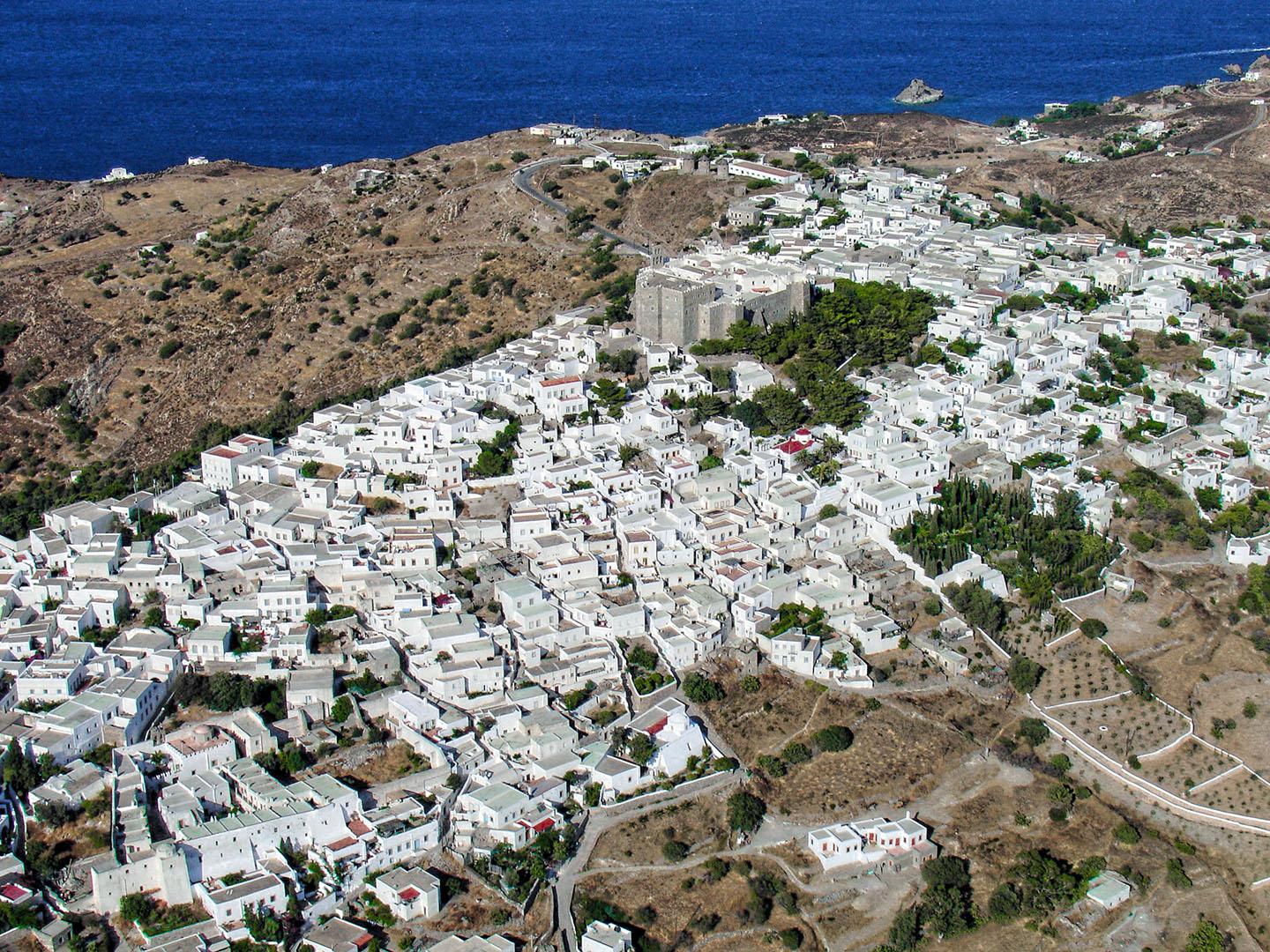
The island remains a significant Christian site. The Cave of the Apocalypse is preserved there, marking the place where John is believed to have received and recorded the visions. It is a modest space in the rock, on a hillside, and pilgrims visit it continuously.
There is an irony in it worth noting. Domitian sent John to Patmos to silence him. The empire that exiled him is gone. The words he wrote in that cave are read in every country on earth.
Revelation opens with a man describing himself as a companion in tribulation, writing from an island he could not leave, to churches he could no longer reach.
Chora, on the island of Patmos. Photo: airphoto.gr, CC BY-SA 4.0, via Wikimedia Commons.