
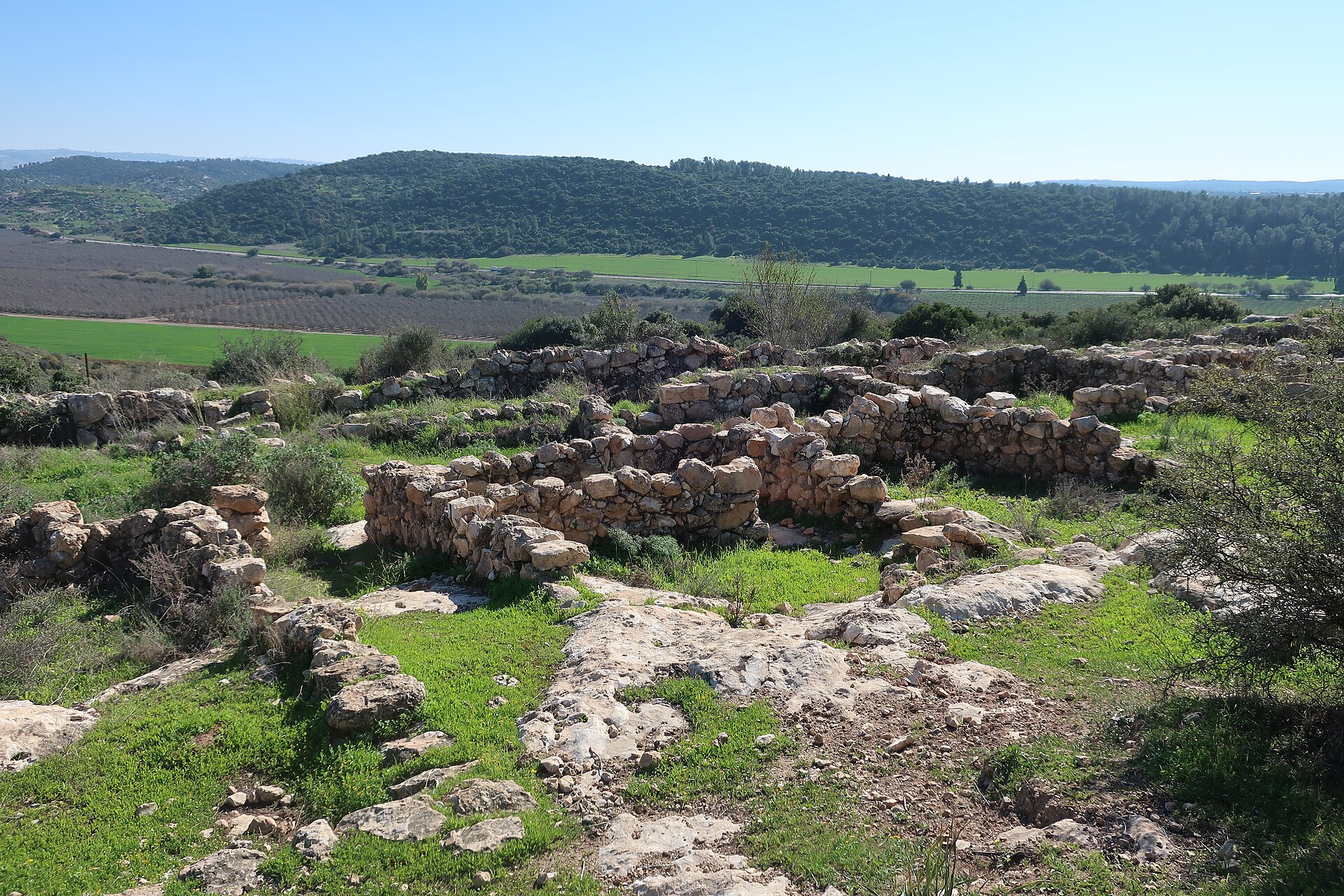
The Elah Valley is where Scripture places one of the most famous confrontations in history — a shepherd boy against a Philistine champion, decided by a sling and a stone.
Excavations at Khirbet Qeiyafa, in that same valley, have produced a fortified city that fits the biblical account of Shaarayim with unusual precision.
The most striking feature is the gates. The site has two of them — and that is genuinely rare. Ancient fortified cities almost always had a single gate, for the obvious reason that every gate is a weakness in your defences. Building a second one meant doubling the section of wall you had to defend. Almost nobody did it.
The Hebrew name Shaarayim means "two gates."
It is the only known city of the period that matches its own name in the archaeological record.
The rest of the picture reinforces it. The city has massive fortification walls, indicating a settlement with real resources and central organisation behind it. Excavators recovered pottery bearing early Hebrew inscriptions. And there is a conspicuous absence — no idols. Cultic figurines turn up routinely at Canaanite and Philistine sites of this era. Their complete absence here is one of the clearest signatures archaeologists have for an Israelite settlement, matching a population that took the prohibition on graven images seriously.
Carbon dating places the site around 1000 BC — the era Scripture assigns to King David.
Then there is the geography. First Samuel 17:52 describes the Philistines fleeing past Shaarayim after Goliath's defeat. The position of Khirbet Qeiyafa sits correctly along that line of retreat, on the frontier between Israelite and Philistine territory — exactly where a border fortress guarding the approach to the heartland would need to be.
The wider implication reaches past a single battle. A fortified city of this scale, this early, with this level of organisation, speaks to a centralised Israelite kingdom capable of commissioning major construction — the kind of state that critics have long insisted did not exist until centuries after David.
The Elah Valley has produced a fortified, two-gated, idol-free Israelite city from David's own century, sitting precisely where the Bible says Shaarayim stood.
Excavations at Khirbet Qeiyafa. Public domain, via Wikimedia Commons.