
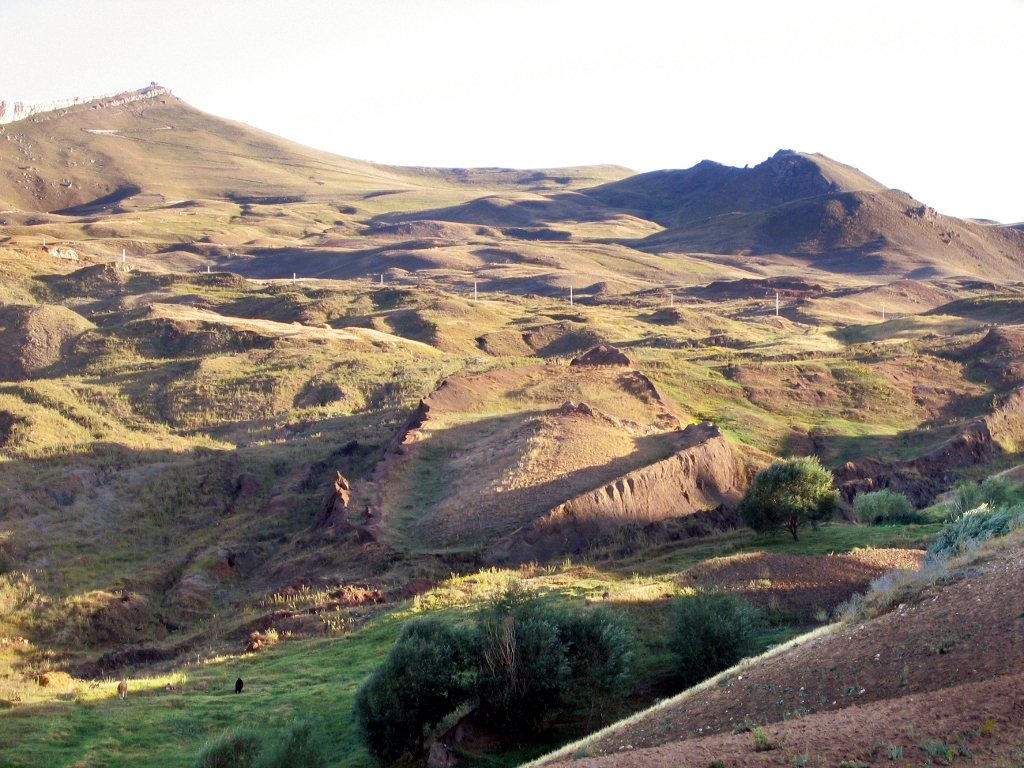
High in the remote mountains of eastern Turkey, in the Durupınar region, there is a formation in the ground that has forced a great many people to reconsider what they had filed away as a children's story.
In 1977, the researcher Ron Wyatt identified it: a boat-shaped formation, 515 feet long, lying in the earth.
That number is the reason it matters. Genesis gives the dimensions of the Ark as 300 cubits in length. Depending on the cubit used, that lands remarkably close to 515 feet. The formation does not merely resemble a vessel in outline — it resembles a vessel of the correct size.
But the shape alone would prove little. Geology produces suggestive outlines. What drew serious attention was what turned up when the site was surveyed with instruments.
Ground-penetrating radar revealed structure beneath the surface — an internal framework consistent with a man-made vessel rather than a natural formation. The scans showed rib-like beams, running in the pattern you would expect from a hull. They showed deck structures, and layered compartments — consistent with Genesis 6:16, which specifies that the Ark was to be built with lower, second, and third storeys.
Metal detectors returned long, regular lines of iron across the formation, in patterns suggesting the remains of metal rivets laid out along structural seams. Natural rock does not distribute iron in straight lines along the joins of a hull-shaped object.
Samples from the site tested positive for fossilised wood, laminated with organic pitch-like substances. Genesis 6:14 records the instruction directly: build an ark of gopher wood, and pitch it within and without with pitch.
Further material reported from the site includes petrified animal dung and coralised antler — the residue of a cargo of animals.
Radar showing a ribbed and decked internal frame. Iron in lines. Fossilised wood carrying pitch. Animal remains. And an outline in the earth measuring 515 feet, high in the mountains of eastern Turkey, exactly where Genesis says the Ark came to rest.
The boat-shaped formation at Durupınar, eastern Turkey. Photo: Mfikretyilmaz, CC BY 3.0, via Wikimedia Commons.