
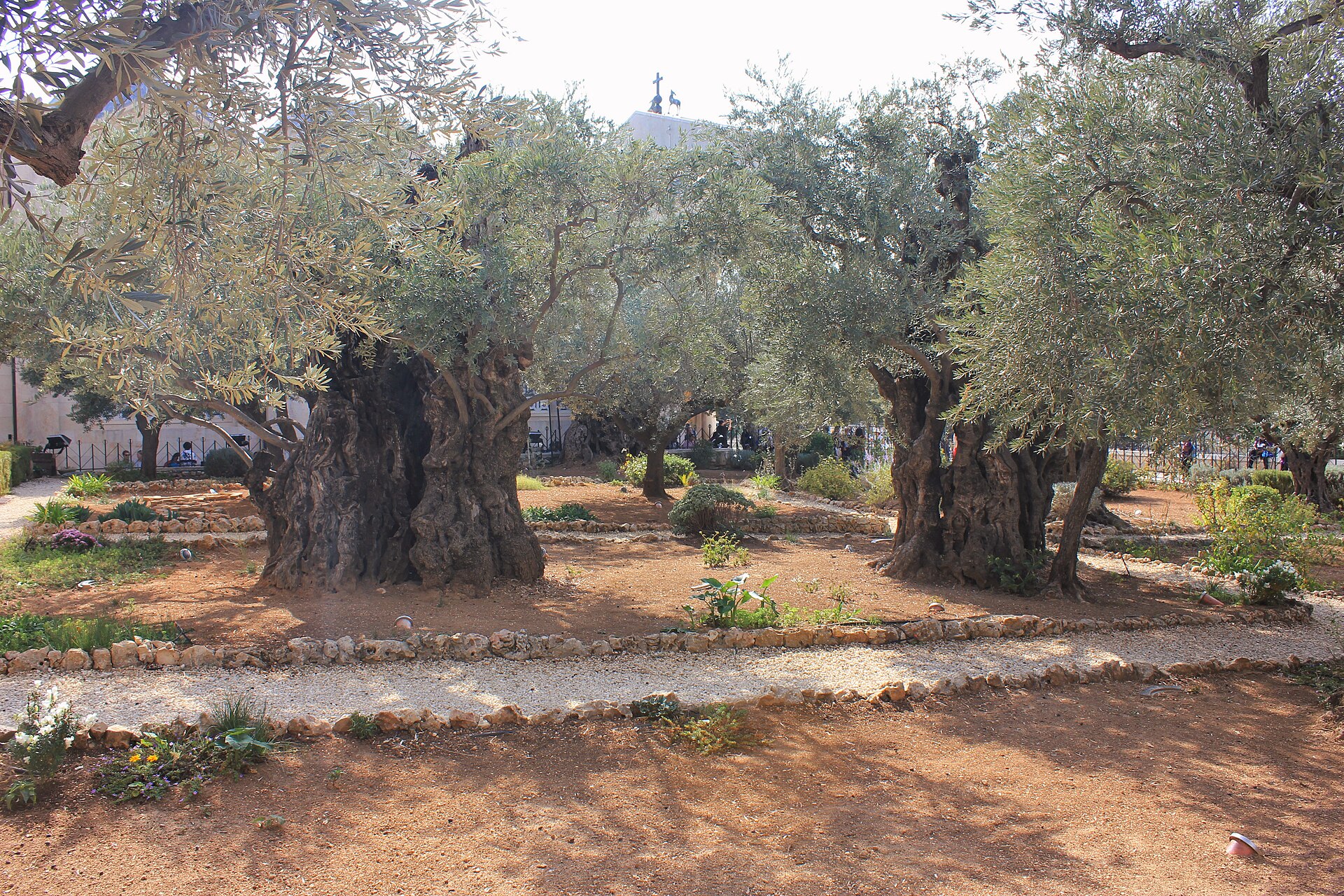
At the foot of the Mount of Olives in Jerusalem lies the Garden of Gethsemane — the place where Jesus prayed on the night He was betrayed.
The name itself carries the history. Gethsemane means "oil press." This was a working olive grove with a press for extracting the oil, and both archaeological evidence and ancient writings confirm that use. It was not a formal garden but agricultural land, on the slope facing the Temple across the Kidron Valley.
All four Gospels place this location at the centre of the night before the crucifixion. Matthew 26:36-56 gives the fullest account: Jesus withdrawing to pray while the disciples sleep, overwhelmed with sorrow to the point of death, praying that the cup might pass from Him and submitting to the Father's will regardless. Then Judas arriving with a crowd, the kiss of betrayal, and the arrest.
The olive trees standing in the garden today are extraordinarily old. Some have been carbon-dated to nearly 900 years, which makes them among the oldest living olive trees anywhere in the world.
That is not old enough to have witnessed the events. But olive trees do not simply die and vanish. When the trunk is destroyed, the root system survives and sends up new growth — a tree can regenerate from its own base for a very long time. Studies suggest the trees standing in Gethsemane today may descend from those present in Jesus's time, grown from the same roots.
Which means the trees in that garden may be the living continuation of the ones that stood there on the night He prayed.
The Church of All Nations was later built on the site, preserving it for the pilgrims who continue to visit. At its heart is a section of exposed bedrock — the rock traditionally identified as the place where He knelt.
An olive grove with a press, at the foot of the Mount of Olives, with ancient trees still growing from roots that may reach back two thousand years.
Ancient olive trees in the Garden of Gethsemane. Photo: Beko, CC BY-SA 4.0, via Wikimedia Commons.