
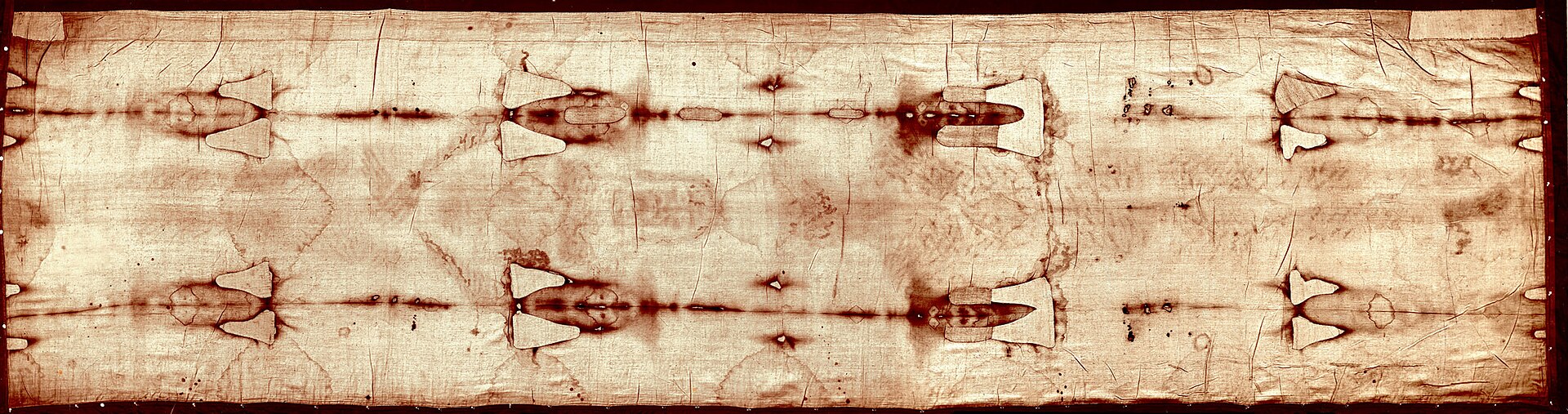
This is the actual burial cloth of Jesus Christ, and after more than a century of scientific examination, no one has been able to account for how the image on it was made.
Start with what the cloth shows. The figure bears nail wounds through the wrists, not the palms — anatomically correct for crucifixion, since a nail through the palm will tear straight out under body weight. Medieval artists, working from convention rather than knowledge, almost always painted the palms. The Shroud does not.
The back is covered in scourge marks, consistent with a Roman flagrum. Around the head are puncture wounds from a cap of thorns. Every detail matches the crucifixion as the Gospels describe it.
The bloodstains are real human blood, type AB. The flow patterns are the part that defeats forgery: blood on the cloth ran according to gravity, in directions consistent with the body's position at each stage — on the cross, and afterwards laid out. No medieval artist possessed the forensic understanding required to fake that, because the forensic understanding did not exist.
But the image itself is the real problem.
It is not painted. There is no pigment. It is not scorched in any way anyone has been able to reproduce. Under magnification, the image exists only on the topmost fibres of the cloth — a superficial discolouration a fraction of the thickness of a human hair, with the fibres directly beneath left untouched.
Researchers examining it concluded that the image was produced by an intense burst of energy — a flash of radiation powerful enough to alter the surface fibres and nothing below them. No natural process is known that does this.
Then there is the three-dimensional data. When NASA imaging technology designed to read topography from light intensity was applied to the Shroud, it produced a coherent 3D relief of a human body. Photographs cannot do this. Paintings cannot do this. The image encodes distance information — the cloth records how far each point of the body was from it.
Pollen embedded in the fibres traces to plants that grow around Jerusalem. The weave matches first-century textile work.
Thousands of tests, decades of examination, and the central question stands unanswered: what produced an image that behaves like a photographic negative, contains depth data, and was seared onto the surface fibres of a linen sheet by a burst of light?
The most important discovery in human history is sitting in a cathedral in Turin, and science cannot explain it.
The Shroud of Turin. Public domain, via Wikimedia Commons.