
Just inside the entrance of the Church of the Holy Sepulchre lies a slab of limestone. Pilgrims kneel at it, press their hands to it, and lay cloths and objects across its surface. It is called the Slab of Anointing — the Stone of Unction — and tradition holds it as the place where the body of Jesus was prepared for burial after being taken down from the cross.
Archaeologists and biblical scholars have assembled a substantial case for that identification.
The slab visible today has been venerated for centuries, and study places it to at least the fourth century AD — the period when the Emperor Constantine ordered the construction of churches at the Christian holy sites in Jerusalem. That in itself is significant, because Constantine's builders were not choosing at random. They were building on locations that local Christians had already been identifying for generations.
But the more important discovery came during restoration work.
Beneath the visible slab, researchers found an older limestone surface — an earlier layer, concealed by the stone that replaced it. Analysis suggests this deeper layer may date to the first century AD, which would place it in the era of the burial itself. The stone venerated today appears to be a covering laid over the original.
Further analysis found traces of ancient burial perfumes and oils embedded in the stone — substances consistent with Jewish burial practice of the period. John 19:39-40 records exactly this: Nicodemus bringing a mixture of myrrh and aloes, and the body being bound in linen with the spices, according to the burial custom of the Jews.
The written record reinforces the physical evidence. Early Christian pilgrims described this as a place of worship — among them Egeria, who travelled to Jerusalem in the fourth century and left a detailed account of what she saw. Her testimony confirms the site was already established as sacred more than sixteen hundred years ago.
An older stone underneath, dated toward the first century. Burial oils in the limestone. An unbroken chain of veneration stretching back to the earliest centuries of the church.
The stone at the entrance is not a medieval invention. It marks the place where the body of Christ was laid out and prepared.
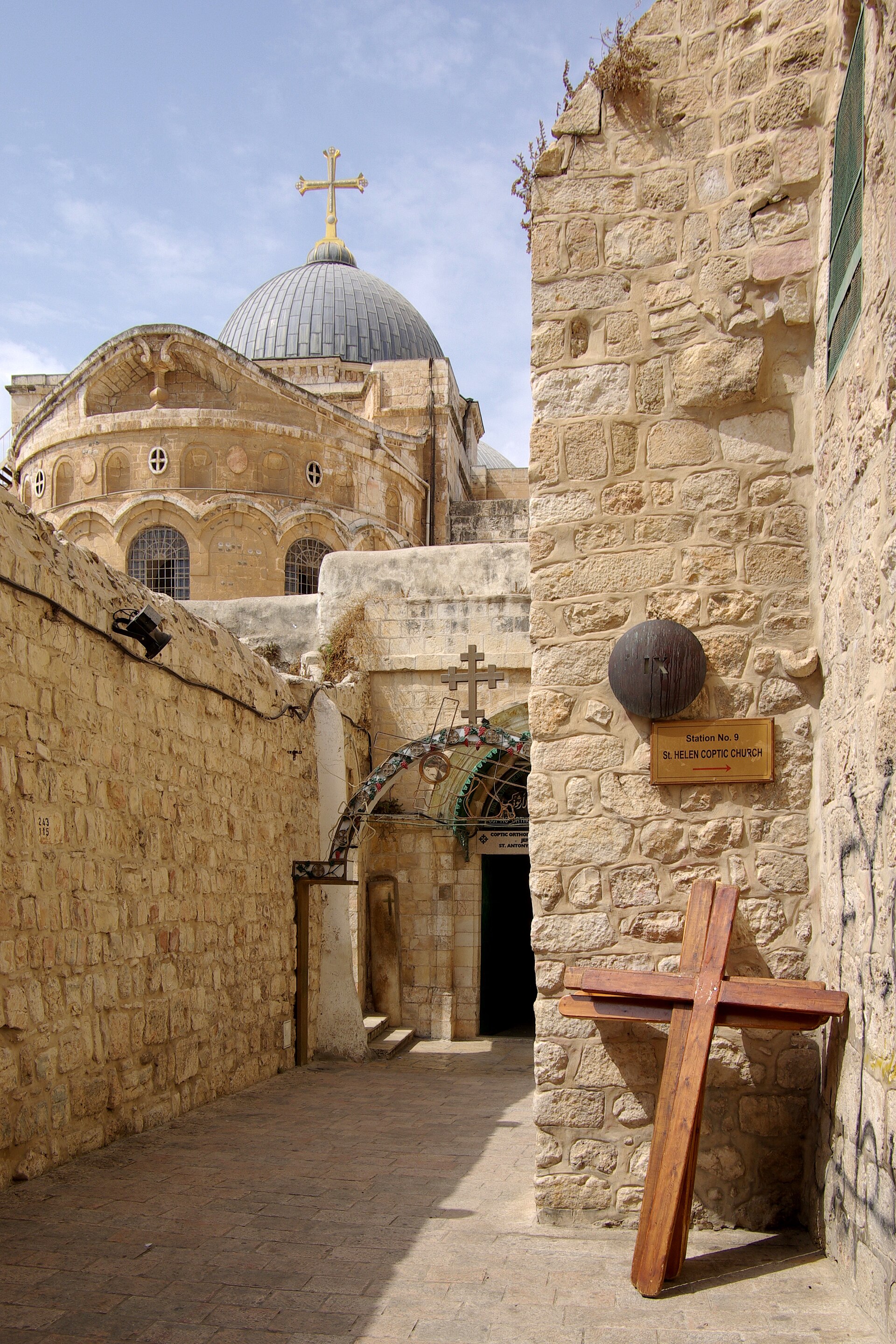
Inside the Church of the Holy Sepulchre, Jerusalem. Photo: Berthold Werner, CC BY-SA 3.0, via Wikimedia Commons.