
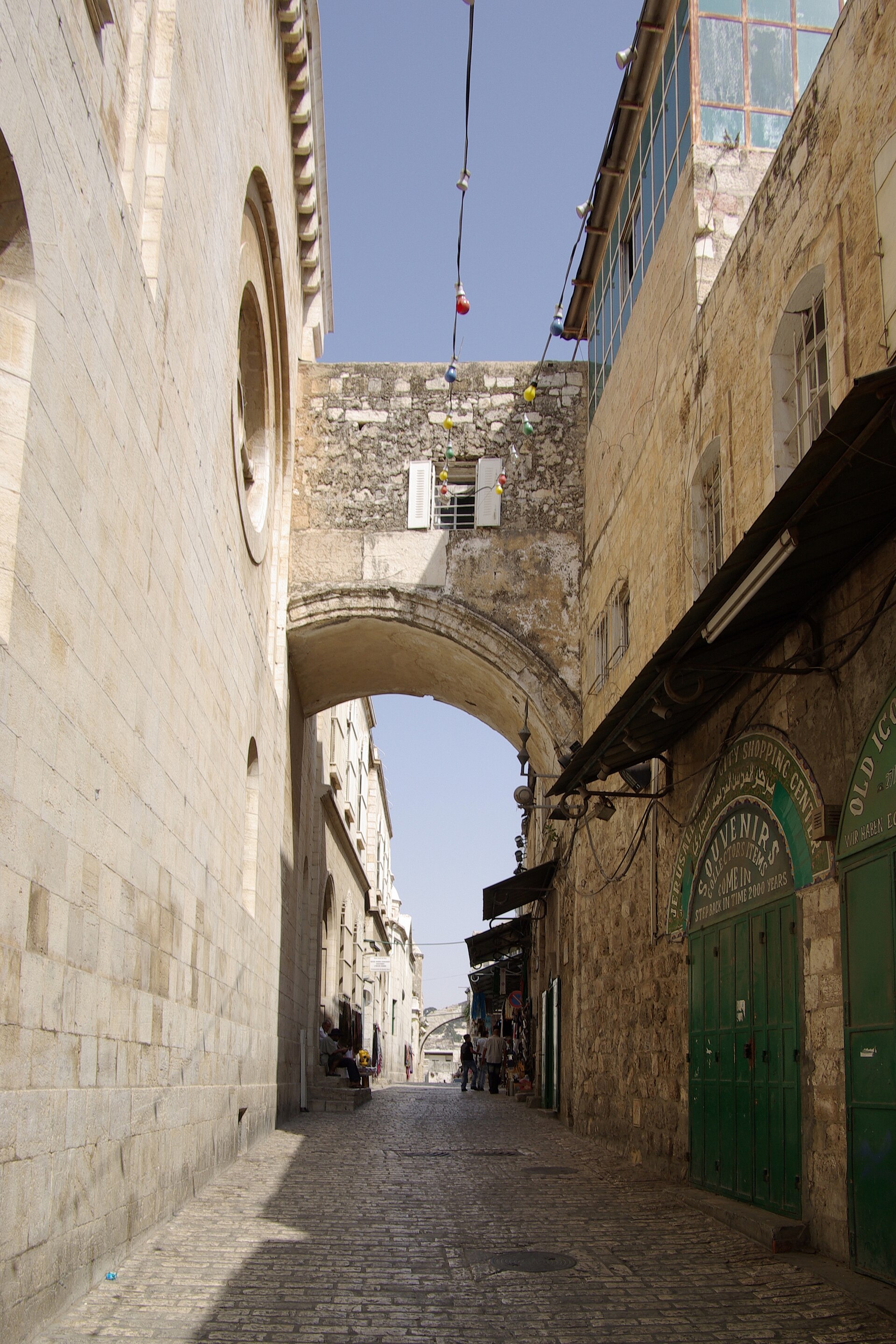
The road Jesus walked carrying His cross is still there. It runs through the heart of Jerusalem's Old City, and it is called the Via Dolorosa — the Way of Sorrows.
Parts of it are still paved with first-century stones. Not a reconstruction, not a marked route through a modern city, but sections of the original surface. The same stones are underfoot.
The route begins at the Roman Praetorium, most likely the Antonia Fortress — the barracks complex overlooking the Temple, where the Roman garrison was stationed and where Pilate would have held judgment. This is where the trial took place, where the crowd was addressed, and where the sentence was passed.
It ends at the Church of the Holy Sepulchre, built over the place of the crucifixion and the tomb — the site where He was executed, where He was buried, and where the tomb was found empty.
Between those two points is a walk of a few hundred metres.
That is worth sitting with, because distance flattens in the retelling. The route Jesus walked between sentencing and crucifixion was short — a matter of minutes at ordinary pace. He had already been scourged. He was carrying the crossbeam. The Gospels record that He fell, and that Simon of Cyrene was compelled to carry it for Him.
These streets are where that happened. Every stumble on this route. Every blow struck along it. Every drop of blood that fell on these stones.
Pilgrims have walked this road for centuries, and it is still walked daily — past shops, through crowds, along an ordinary working street in a living city. The setting has changed around it. The route has not.
The road where the Son of God carried His cross has an address, and you can stand on it.
Every step of it was for you.
The Via Dolorosa, Jerusalem. Photo: Berthold Werner, CC BY-SA 3.0, via Wikimedia Commons.